 Bullhead City Mobile Home Leveling
 Mobile Home Leveling & Releveling in Bullhead City
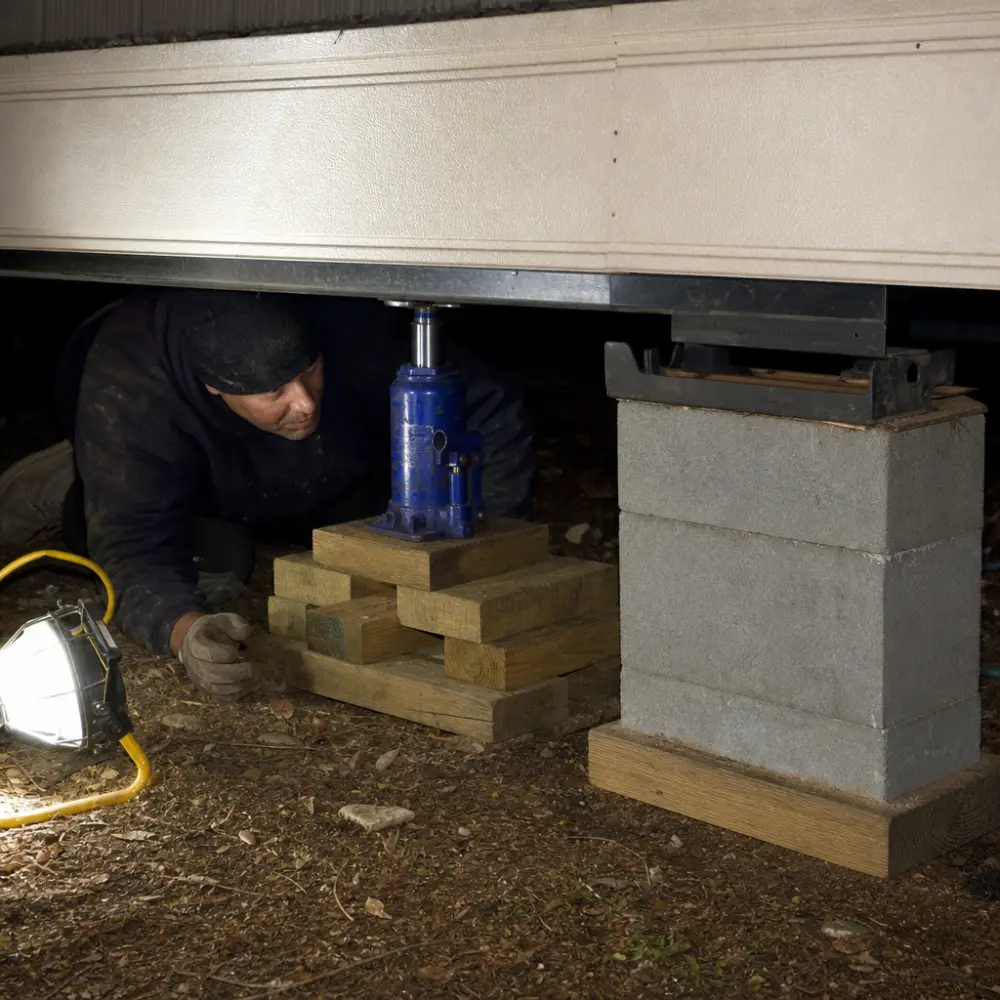
Releveling puts a flat, evenly supported steel chassis back under a manufactured home after its piers settle or shift. The crew maps every pier with a water level, lifts the I-beams with 20-ton hydraulic jacks carried on solid cribbing, and rebuilds each low pier with fresh hardwood shims until the whole frame reads level again. Singlewides run $450 to $800, doublewides $750 to $1,400, and nearly every home in Bullhead City, Fort Mohave, and Lake Havasu City is done in a single day.
If doors have started sticking, a floor has developed a lean, or the ceiling seam on a doublewide has opened up, this is the service that fixes it.
Why homes settle here, and why it is slower than Florida
A manufactured home carries its whole weight through a few dozen pier footprints, each around one square foot. What is under those footprints decides how often you need us.
Around Bullhead City that is desert ground which, on the whole, bears a pier well: dry, well drained, and frequently lime-cemented with the caliche everyone here has hit with a shovel. That is the honest reason a home set properly on this ground does not need the three-to-five-year relevel cycle that sandy Florida ground demands.
It still moves, for four reasons we see under homes every week:
- Old lots were never prepared. Much of the park stock along AZ-95 and the older county roads went in decades ago, on ground that was raked flat and nothing more. Arizona’s installation rules today expect a site to shed water away from the home, and flat is not the same as draining. Water sits where those pads are.
- Loose ground consolidates. River valley soils here are sandy alluvium, and out toward Golden Valley you are on alluvial fans, material that water carried off the mountains and dropped. Neither swells and shrinks like Phoenix clay. Under a pier concentrating thousands of pounds on a pad a foot or two square, they compact, unevenly, following wherever the fill was least compacted when the home was set. The home twists rather than sinking.
- Monsoon runoff. The monsoon runs June 15 through September 30, and it delivers rain faster than the ground can absorb it. What cannot soak in runs across the surface, and running water in loose desert soil carries material out from beside a footing pad. Once the soil beside a pad is gone, the pad tips. Where runoff concentrates, at a roofline or in the path water has always taken across a lot, is where the piers move.
- Heat. Bullhead City summers are among the most severe in the country, and the crawl space under a closed-up home is hotter still. Hardwood shims and lumber caps dry, check and shrink under four months of it, and crush under sustained load besides. A shim that was tight in March can be loose in September.
Add the fact that a large share of these homes sit empty from May to October while their owners are somewhere cooler, and nobody notices the doors until they come back.
What settling looks like from inside
- A door that rubs at one corner, then drags, then will not latch.
- Windows that bind in their tracks.
- A slope you can feel walking the hallway, or a bounce in one room. Put a marble down; if it travels, the piers have moved.
- Hairline cracks at the top corners of door and window openings.
- On a doublewide, the marriage line opening at the ceiling or a ridge in the floor along the seam.
- Skirting bowing or popping out of its track with no impact damage.
Early settling is a reshim inside the base price. Settling left through a few monsoon seasons turns into pier rebuilds, and every season adds piers to that list.
How the relevel works
1. Survey. Skirting access panels come off and the crew crawls the home end to end. Every pier gets shot with a water level off a datum pier, the most stable one, so each I-beam point has a number: this pier is down three quarters of an inch, this one an inch and a half, these six are true. While under there they check every pad, cap, and shim for crush and rot, look at the belly wrap, and handle every anchor strap. You get the map and a firm written price before anything is lifted.
2. Lift. Twenty-ton bottle jacks on solid wood cribbing at the frame near each low pier. The rule that separates competent work from dangerous work: the cribbing carries the load, never the jack alone. Lifting happens in small increments, station to station, so the chassis returns to plane as a unit instead of being cranked at one point.
3. Rebuild the piers. Federal installation standards at 24 CFR 3285.304 are specific about what goes between a pier and the beam: nominal 4 by 6 by 1 inch hardwood shims, used in pairs, driven tight, taking up no more than one inch of vertical height, with any remaining gap filled by a hardwood plate no thicker than 2 inches nominal or a 2 or 4 inch solid block. A pier that cannot reach the beam inside that allowance gets rebuilt at the right height with new blocks and a proper cap, not stacked taller with scrap. Frame piers over 36 inches tall have to be double-stacked and interlocked under 24 CFR 3285.306, which matters on sloped lots in Fort Mohave and along the mountain front.
4. Verify. The whole frame is re-shot. Every pier has to carry load, checked by hand, because a pier you can rattle is holding nothing. On a doublewide, both halves must read matched along the center row and the marriage line has to close.
5. Re-secure. Raising the home changes the tension the anchor straps were set at, so they get re-tensioned. If the anchor system is short, corroded, or missing entirely, which is common under 1970s and 1980s park units here, you get told and it is quoted separately as tie-down work. Skirting goes back on.
Singlewides, doublewides, and park models
A singlewide has two I-beam rails and typically 12 to 20 piers; 3 to 5 hours, $450 to $800.
A doublewide adds the marriage line, the center pier row carrying the joined edges of both halves. Those piers have to come back up matched to both sections at once or the seam stays stressed at the ceiling, floor, and roof connection. It is slower, more careful work: $750 to $1,400 and 6 to 8 hours.
A park model, the compact units that fill the resorts up and down the river valley, is a small singlewide as far as the frame is concerned. Same survey, same lift, fewer piers, and it prices at the bottom of the singlewide range.
What moves the number
| Situation | Expect |
|---|---|
| Routine relevel, most piers reshimmed | $450 to $800 single, $750 to $1,400 double |
| Piers needing reset | add $75 to $150 per pier |
| Piers needing full rebuild | add $150 to $400 per pier |
| Sloped lot, tall piers, tight access | quoted after survey |
The pricing page has the complete tables. Every number is confirmed in writing after the free survey, from pier readings rather than a phone guess, and it lands the same day.
Licensed installers, by law
Arizona Revised Statutes section 41-4001 defines installation to include placing a home on its foundation system or repairing that foundation system, and providing or repairing its ground anchoring. Section 41-4047 makes it unlawful to engage in the business of installing manufactured or mobile homes without an installer license from the Arizona Department of Housing, whose Office of Manufactured Housing licenses the trade. The state’s I-10C general installer class specifically covers ground anchors and tie-downs. All leveling work arranged through us is performed by licensed, insured Arizona manufactured home installers. Ask every bidder the same question.
After the relevel
The relevel fixes the elevation. It does not change the ground. Three things stretch the interval here: keep roof and yard runoff moving away from the pier lines instead of pooling under the skirting, keep the skirting vented so the crawl space dries after a storm, and fix the pad problems we flag instead of reshimming over them. Owners who do that get a long cycle on this ground.
Request a free level check. We cover Bullhead City, Fort Mohave, Lake Havasu City, Mohave Valley, Golden Valley, and Kingman, and the pier-by-pier answer costs nothing.
Frequently Asked Questions
What does it cost to relevel a mobile home in Bullhead City?
Singlewides run $450 to $800 and doublewides $750 to $1,400, including the pier survey, the lift, new shims, and a strap re-tension. A park model prices at the bottom of the singlewide range. Homes that need piers rebuilt rather than reshimmed run higher, quoted per pier before any work starts. The level check itself is free.
How often does a mobile home need releveling in Mohave County?
Less often than on wet ground back east, but it still recurs. Desert alluvium is dense and dry most of the year, so a well-set home on a prepared pad can go many years. Homes on old park lots that were never graded, on sandy fan soils near a wash, or on the clay-loam subsoils mapped across the Lake Havasu City side of the valley move sooner. Monsoon runoff and summer heat cycling do the work. A free check every few years tells you where you stand.
Will lifting the home crack my drywall?
Careful lifting is what prevents that. Damage happens when one point gets cranked far out of plane with a single jack. We lift in fractions of an inch across several stations so the chassis returns to level as a unit. A home that sat badly settled for years may have existing cracks that close up, and occasionally reveals ones the settling caused, but the lift itself is not what cracks walls.
Do you level park models in the resorts?
Yes. Bullhead City's resort stock is heavily park models, and they settle, rack, and stick doors the same way a HUD home does, just on a smaller frame. The survey and lift are the same process on a smaller scale, which is why they price at the low end of the singlewide range. Resort management is looped in where the park's rules require it.
Is releveling licensed work in Arizona?
Yes. Arizona law defines installation to include placing a home on its foundation system or repairing that system, and repairing its ground anchoring, and it is unlawful to be in the business of installing manufactured homes without an installer license from the Arizona Department of Housing. Every crew arranged through us is a licensed, insured Arizona manufactured home installer, and you are welcome to verify that before anyone goes under the home.