 Bullhead City Mobile Home Leveling
Bullhead City Mobile Home Leveling puts settled manufactured homes and park models back on the level line across Bullhead City, Fort Mohave, Lake Havasu City, and the rest of Mohave County. Every pier gets mapped with a water level, the frame comes up on hydraulic jacks carried by solid cribbing, and each low pier is rebuilt with fresh hardwood shims until the whole chassis reads flat. A singlewide relevel is $450 to $800 and a doublewide $750 to $1,400. The survey that tells you exactly what your home needs costs nothing.
Sticking doors, a floor with a lean in it, a ceiling seam that has opened up on a doublewide: those are the reasons people call, and in this town they usually call in October.
The town this business is built for
Bullhead City sits on the Colorado River in Mohave County, across the water from Laughlin, and its population swells every winter the way the whole lower river corridor does. The valley from Bullhead City south through Fort Mohave and Mohave Valley, and on down to Lake Havasu City, is full of manufactured homes, park models and RV resorts, and a large share of them belong to people who are here from roughly November to April and somewhere cooler the rest of the year.
That is a great many park models, singlewides and doublewides sitting on block piers, empty from May through October, through the hottest and stormiest part of the year. Nobody is under them. Nobody notices the doors until they come back in the autumn.
It is the single most important fact about this market, and it shapes how we schedule: the damage happens in the months the owner is not here, so the useful time to look is before you leave and before you return, not a month after you are back.
The ground is the reason, and it is a different reason than back east
A manufactured home concentrates its whole weight through a few dozen pier footings, each bearing on a pad about a foot or two square. Under this valley those footings press into desert ground that is, on the whole, better than most of the country: dry, well-drained, often lime-cemented with the caliche everyone here has hit with a shovel. Dense dry ground bears a pier well.
That is the honest reason a home set correctly on this ground does not need the three-to-five-year relevel cycle that Florida sand demands, and anyone who tells you otherwise has not spent much time under homes here.
It still moves. Four reasons, in the order we find them:
Old lots were never prepared. A lot of the park stock along AZ-95 and the older county roads went in decades ago on ground that was raked flat. Arizona’s installation rules now expect a site to shed water away from the home, but flat is not draining, and water sits where those pads are.
The ground is loose where it is not cemented. River valley soils here are sandy alluvium, and out toward Golden Valley you are on alluvial fans, which are by definition material that water carried down off a mountain range and dropped. Neither swells and shrinks the way Phoenix clay does. What they do is consolidate under a concentrated load, unevenly, following wherever the fill was least compacted when the home was set. A home on this ground does not sink. It twists.
Monsoon water. Arizona’s monsoon runs June 15 through September 30, and the defining feature is intensity rather than total rainfall: rain arrives faster than the ground can absorb it. What cannot soak in runs, and running water in loose desert soil carries material out from beside footing pads. Once the soil beside a pad is gone, the pad tips. Anywhere runoff is concentrated, at a roofline, a gap between homes, or the path water has always taken across a lot, is where the piers move.
Heat. Bullhead City summers are among the most severe in the country, and the crawl space under a closed-up home is hotter still. Hardwood shims and lumber caps dry, check and shrink over four months of that, and they crush under sustained load besides. A shim that was tight in March can be loose in September without anything dramatic having happened.
The upshot is a long maintenance interval rather than no interval. Homes here go years between relevels. Homes on ungraded lots in a runoff path, or set cheaply on unprepared ground, come back sooner. Either way the check is free.
What settling looks like from inside the house
- Doors rub, then drag, then stop latching. The frame has racked and the opening is no longer a rectangle.
- Windows bind in their tracks.
- Floors slope or bounce. Put a marble down. If it travels, you are not imagining it.
- Cracks open at wall and ceiling joints, most often above doorways.
- A doublewide’s marriage line opens at the ceiling because the two halves are no longer at matched height. Owners live with this one longest because it is overhead.
- Skirting bows or pulls away as the home descends onto panels never meant to carry weight.
Any of those earns a free level check. Settling compounds: a pier that is an inch low is grinding its own cap and shims, and it will be lower after next monsoon. Caught early it is a straightforward relevel. Left for a few more seasons it becomes pier rebuilds, and the difference on the invoice is measured in hundreds of dollars.
What a relevel involves
The survey. Access panels off, crew under the home end to end, every pier shot with a water level off a datum pier. You get a number per pier rather than an opinion. Pads, caps, and shims get handled rather than glanced at, the belly gets checked, and every anchor strap gets looked at. The written price comes out of this, before anything is lifted.
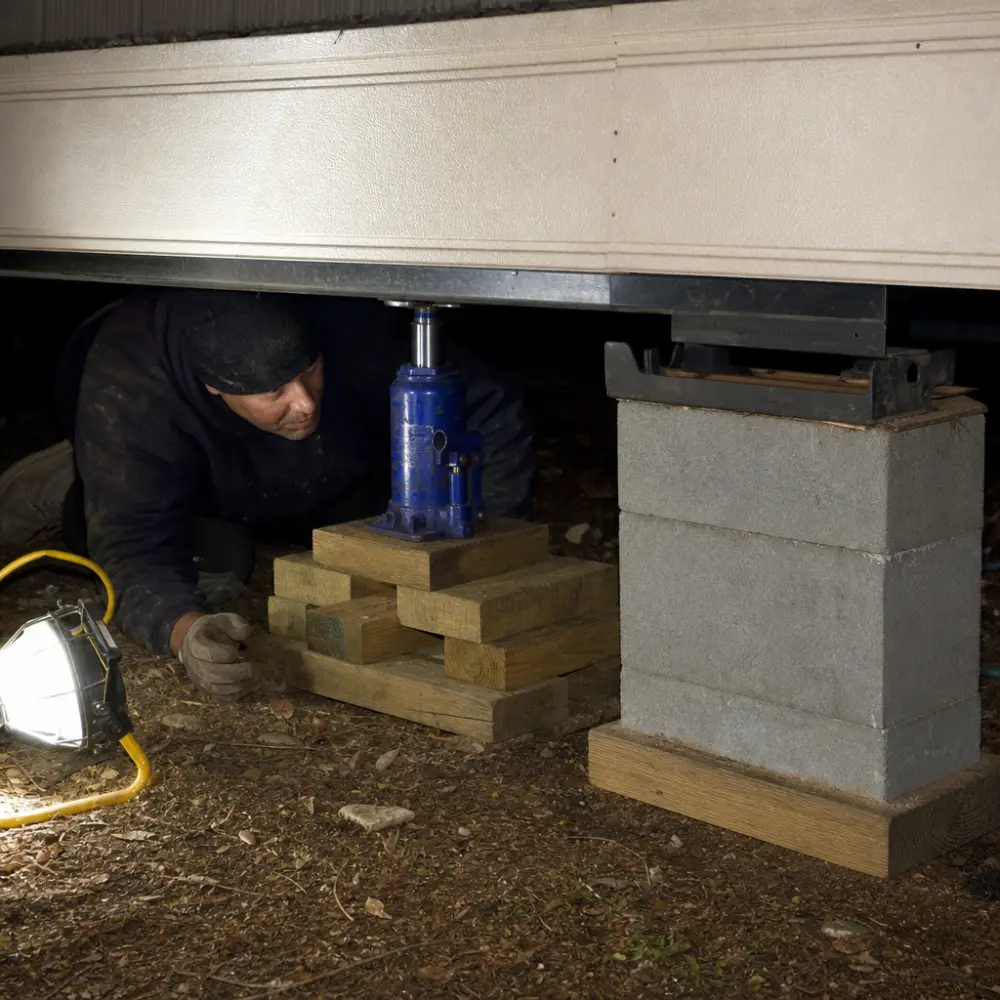
The lift. Twenty-ton bottle jacks on solid wood cribbing at the frame near each low pier, working in small increments across multiple stations so the chassis returns toward plane as a unit. The rule that separates competent work from dangerous work: the cribbing carries the load, never the jack.
The pier work. Blocks re-stacked or replaced, crushed caps and pads swapped out, hardwood shims driven tight in pairs. The federal installation standard at 24 CFR 3285.304 allows one inch of paired shims plus a two-inch plate under the beam; a pier that cannot reach inside that allowance gets rebuilt at the right height instead of stacked taller, priced separately and openly.
The verification. The frame is re-shot end to end. Every pier has to be carrying load, confirmed by hand. On a doublewide, both halves have to read matched at the center row.
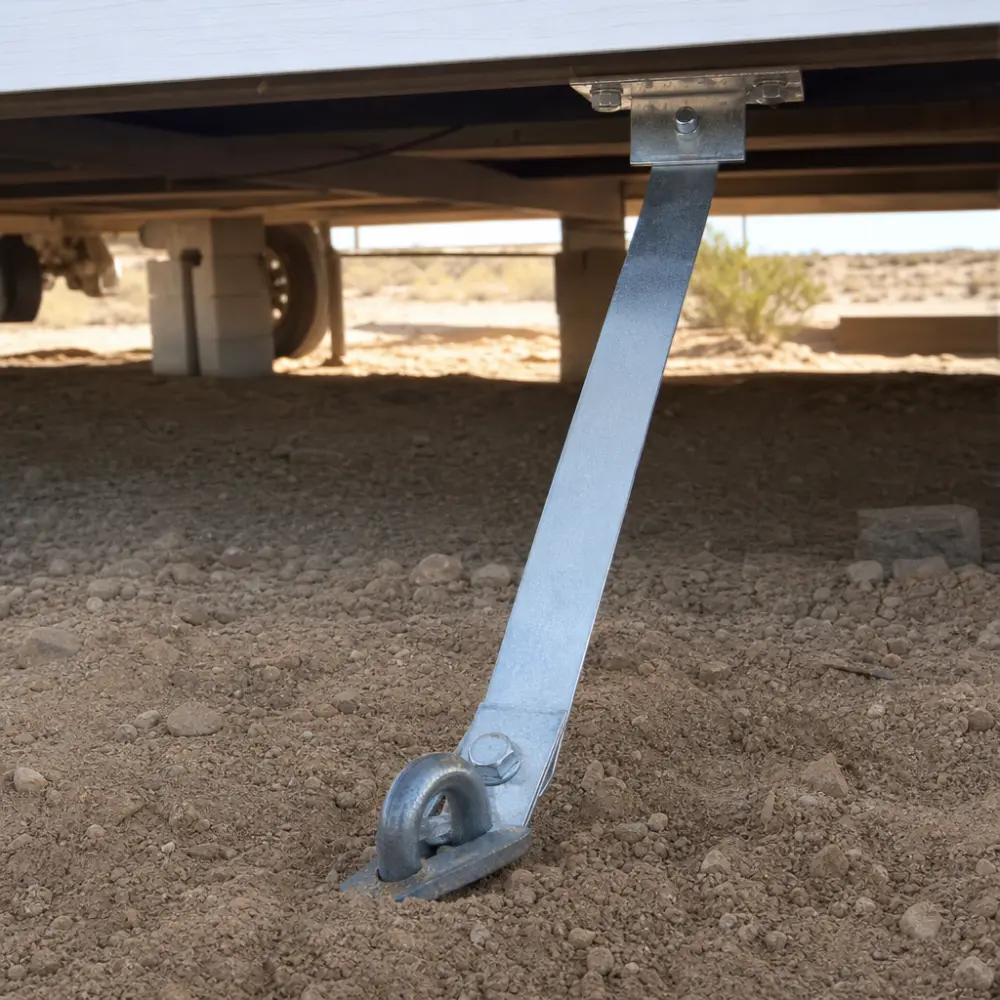
The straps. Anchor straps get re-tensioned, because raising the home changes the tension they were set at. If the anchor system is short, corroded, or missing, which is common under 1970s and 1980s park units, you get told and it gets quoted separately.
Everything we do
- Mobile home leveling. The core service. Survey, lift, shims, whole-frame verification, most homes and park models in a day.
- Pier and pad repair. Reset, reshim, or fully rebuild settled piers and the footings under them. $75 to $150 a pier to reset, $150 to $400 to rebuild.
- Tie-downs and anchors. Install, replace, and re-tension ground anchors and straps, pre-drilled where the caliche is shallow. $600 to $3,500.
- Vapor barrier replacement. Repair or replace the belly board that keeps heat, dust, rodents, and water out of the floor cavity.
- Skirting repair. Panels, vents, and access doors, including the storm and sun damage every summer delivers.
- Pre-sale leveling inspection. A written level, support, and anchoring report for parks, buyers, sellers, and lenders. $150 to $350, credited toward any work it finds.
- Mobile home transport and setup. Full pull-and-set with the state and county permits handled, itemized from a site visit.
The rates, published
Almost nobody in this trade will give you a number before they are standing in your yard. Ours have been on the website since it went up.
| Service | Typical range |
|---|---|
| Relevel, park model or singlewide | $450 to $800 |
| Relevel, doublewide | $750 to $1,400 |
| Pier reset or reshim | $75 to $150 per pier |
| Pier rebuild | $150 to $400 per pier |
| Anchors and tie-downs | $600 to $3,500 |
| Vapor barrier | $300 to $800 patch, $1,200 to $4,500 full |
| Skirting | $200 to $800 repair, $900 to $2,500 full |
| Pre-sale inspection | $150 to $350 |
| Transport and setup | $5,000 to $8,000 single, $8,000 to $15,000 double, itemized |
Every leveling job starts with the free survey and ends with a firm written number. Full detail and what pushes a job inside its range is on the pricing page.
Washes and flood maps
The washes through this county are dry until they are not, and where a home sits relative to one matters a great deal more than most owners realise. A wash that runs once in a decade still decides whether the ground beside your footings is there afterwards.
For a routine relevel of a home already sitting where it sits, none of this changes the job. For a set or a move it changes everything: the Arizona Department of Housing will not issue an installation permit in a mapped flood zone without a site-specific foundation plan by an Arizona registered engineer, approved and red-stamped first, and Mohave County requires its own floodplain permit on top of that. That is one reason setup is quoted from a site visit rather than from a table.
If you do not know whether your address is in a mapped zone, it is worth finding out before you plan any work that touches the foundation, and it is free to check with the county.
Wind Zone I, and why anchors still matter
The federal construction standard at 24 CFR 3280.305 puts Arizona in Wind Zone I, the lowest of three zones; the 100 and 110 mph zones are named lists of Gulf and Atlantic coast counties, Hawaii, coastal Alaska, and the territories. That governs how the home is built. It does not excuse the anchoring. The state adopted the federal installation standards in 24 CFR 3285 by reference, and those require every ground anchor to carry a 3,150-pound working load and every home to be stabilized against wind in all zones. The Department’s installation FAQ says it in one sentence: all mobile homes and all used and new manufactured homes must be anchored.
The wind is monsoon outflow. The Weather Service defines the season as June 15 through September 30, warns at 60 mph, and notes the strongest straight-line gusts can exceed 100 mph. Straps go slack every time a home settles, and under the older park stock we find no anchors at all more often than we should. Which is why leveling and tie-down work are one conversation here, and straps are re-tensioned as part of every relevel.
Who is allowed to do this work
Arizona Revised Statutes section 41-4001 defines installation to include placing a home on its foundation system or repairing that foundation system, and providing or repairing its ground anchoring. Section 41-4047 makes it unlawful to engage in the business of installing manufactured or mobile homes without an installer license from the Arizona Department of Housing, whose Office of Manufactured Housing licenses the trade. The state’s rules at A.A.C. R4-34-802 say installation shall be performed only by a properly licensed entity, to the federal standards and the manufacturer’s instructions, after assessing the site and soil. The I-10C general installer classification specifically covers ground anchors and tie-downs. Licensees get there with three years of field experience, the Manufactured Housing Educational Institute’s installer course, and a fingerprint clearance card.
We bring all that up unprompted because it protects you. Every crew arranged through us is a licensed, insured Arizona manufactured home installer. Ask every bidder for the same and pay attention to who gets quiet.
Where we work
Crews cover Mohave County out of Bullhead City: Fort Mohave and Mohave Valley south down the river valley on AZ-95, Golden Valley out on the fans toward the Black Mountains, Kingman at the top of the grade, and Lake Havasu City further south down the river. Fort Mohave and Mohave Valley are the closest and schedule same-week in normal seasons; Golden Valley and Kingman take a little more notice; Lake Havasu City is scheduled rather than dispatched, and there is no travel surcharge anywhere in the county.
Book the free level check
Tell us what you are noticing, a door that will not close, a hallway with a lean, a seam that has opened, along with the home’s size and where it sits. A crew comes out, shoots every pier, and writes the price at the home while the readings are fresh. You get a pier-by-pier map, a firm number, and a straight answer about what needs doing now versus what can honestly wait until spring. Questions first? The FAQ covers most of them, or read how we work.